


How Much Compensation Does a Disabled Veteran Receive?
A veteran who is wholly or partly disabled by a service-connected medical condition may be entitled to monthly monetary compensation and other benefits. The amount of VA disability benefits a veteran receives will depend on factors such as:
- The VA disability rating assigned
- The number and type of dependents the veteran has
- Whether the veteran qualifies for special monthly compensation in place of or in addition to their regular disabled veterans benefits
Here’s what you need to know about VA disability compensation rates, how they are determined, and when you may be entitled to more than the standard base amount for your disability rating.
Current VA Disability Compensation Rates
The base amount of disabled veteran benefits changes from year to year, as the VA applies an annual cost of living adjustment (COLA). This increase is based on consumer price data, and is calculated by the Social Security Administration (SSA) each year.
The current rates took effect December 1, 2025, reflecting a 2.8 percent COLA. Because rates change every December 1 and first appear in the payment issued at the start of January, any rate chart you find online is worth checking against the date on it.
These are the monthly amounts for a veteran with no dependents.
| Disability rating | Monthly payment |
| 10% | $180.42 |
| 20% | $356.66 |
| 30% | $552.47 |
| 40% | $795.84 |
| 50% | $1,132.90 |
| 60% | $1,435.02 |
| 70% | $1,808.45 |
| 80% | $2,102.15 |
| 90% | $2,362.30 |
| 100% | $3,938.58 |
In some circumstances, a disabled veteran may be assigned a 0% disability rating. That rating entitles the veteran to healthcare services for their service-connected condition or conditions, but does not qualify for monthly monetary benefits.
A 0% rating is still worth having. It establishes service connection, which means if the condition worsens later you are asking for an increase rather than starting a new claim and proving the connection all over again.
Notice how uneven the jumps are. Going from 10% to 20% adds about $176 a month. Going from 90% to 100% adds more than $1,576. The gap between 90% and 100% is the largest single step in the entire table, which is why that last 10 percent is worth fighting for and why TDIU matters so much.
Call 1-888-373-4722 or complete a Free Case Evaluation form
Why Your Ratings Do Not Add Up the Way You Expect
This is the single most common source of confusion about VA compensation, and it catches nearly every veteran with more than one rated condition.
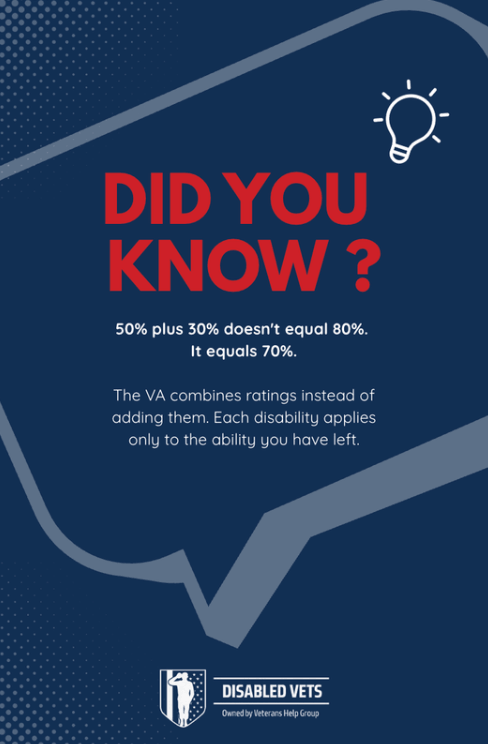
If you are rated 50% for one condition and 30% for another, your combined rating is not 80%. The VA does not add ratings. It combines them, using what veterans usually call VA math.
The logic is that each disability applies to whatever ability you have left. Start at 100 percent efficient. A 50% rating takes half, leaving you 50 percent efficient. The 30% rating then applies to what remains, taking 30 percent of that 50, which is 15. Add the 50 and the 15 and you get 65. The VA then rounds to the nearest 10, so your combined rating is 70%.
Two consequences follow from this, and both matter.
Each additional rating is worth less than the one before it. A new 10% rating added to an existing 80% combined rating moves you very little. That is why chasing several small conditions often produces no change in your check, and why veterans are frequently confused when a granted claim does not raise their payment at all.
Rounding can work in your favor. A combined value of 65 rounds up to 70%, which is worth $1,808.45 rather than $1,435.02 at 60%. A single additional rating that pushes you from 64 to 65 is worth more than $370 a month. This is worth having someone actually calculate rather than guessing.
Additional Monetary Benefits for Veterans with Dependents
A veteran with a disability rating of less than 30% does not receive additional monetary benefits for dependents. However, at every level from 30% through 100%, there are add-on amounts available for certain dependents. These include spouses, minor children, children between the ages of 18 and 23 who are in school, and parents.
Both the amount of the increase and the standard applied to determine whether the veteran is eligible for the increase are different depending on the type of dependent. The amount of the increase also varies based on the veteran’s disability rating.
There are too many variations to lay them all out here, but here are a few common examples.
A veteran with a 50% rating receives $1,132.90 a month with no dependents. With a dependent spouse, that rises to $1,241.90. With a spouse and one minor child, $1,322.90. That is an increase of $190 a month, or about 17 percent.
The same veteran rated 100% would receive $3,938.58 alone, $4,158.17 with a spouse, and $4,318.99 with a spouse and one child. That is an increase of $380.41 a month, or about 10 percent.
Beyond the first child, each additional child under 18 adds $109.11 a month at the 100% level and $54 at the 50% level. A child over 18 enrolled in a qualifying school program is worth considerably more: $352.45 a month at 100% and $176 at 50%. If your spouse receives Aid and Attendance, add $201.41 at the 100% level.
Dependents Are Not Added Automatically
This is where money gets left on the table more often than anywhere else on this page.
The VA does not know you got married, had a child, or that your 18-year-old enrolled in college. You have to tell them, using VA Form 21-686c for a spouse or child, or VA Form 21-674 for a child over 18 in school. Until you file it, you are being paid at the veteran alone rate.
File within one year of the event, meaning the marriage, birth, or enrollment, and the additional amount can be paid back to the date of the event. File later and it generally starts from the date the VA receives your form. A veteran at 100% who married three years ago and never told the VA has been underpaid roughly $220 a month, and most of that is not recoverable.
The reverse is also true and matters just as much. A divorce or a child aging out has to be reported, because the VA will eventually catch it and create an overpayment it can collect from future checks.
Special Rules for Dependent Parents
While spouses and minor children automatically count as dependents, parents are considered dependents only if certain conditions apply. The first is that the parent be an actual dependent, in the sense that the veteran is contributing directly to their support. The second is financial. A parent qualifies as a dependent only if their income and net worth fall below certain thresholds.
The cut-off to be presumed a dependent is very low. However, a parent whose resources are above that level may still be considered a dependent based on a more detailed analysis.
The amounts are meaningful. At 100%, a veteran with a spouse and one dependent parent receives $4,334.41 rather than $4,158.17. The form is VA Form 21-509.
Call 1-888-373-4722 or complete a Free Case Evaluation form
Exceptions to Rating-Based Disability Benefits
While VA disability benefits are typically determined by the veteran’s disability rating, there are some exceptions.
TDIU and Disability Benefits
Under certain circumstances, a veteran who is unable to work due to a service-connected condition may be designated TDIU–totally disabled due to individual unemployability. A veteran who receives this designation is eligible to receive benefits as if they had a 100% disability rating.
To receive TDIU classification, a veteran must be unable to engage in substantial gainful activity due to a service-connected medical condition or combination of service-connected conditions. The impact of non-service-connected medical conditions will not be considered.
In most circumstances, a minimum VA disability rating is required. The threshold is either a rating of at least 60% for a single service-connected disability or a combined rating of at least 70% with one condition rated at least 40%. However, in rare circumstances the VA may award an “extraschedular” TDIU classification even when these conditions are not met.
The financial case for TDIU is straightforward. A veteran rated 70% receives $1,808.45 a month. The same veteran granted TDIU receives $3,938.58. That is a difference of $2,130.13 every month, more than $25,000 a year, without the rating percentage changing at all.
Special Monthly Compensation
Special monthly compensation (SMC) works in two different ways. Most types of SMC have their own higher base rate of monthly compensation, though a couple of types are add-ons to the regular rating-based monthly amount.
For a veteran alone, SMC base rates currently start at $4,408.53 a month at the SMC-S level, which covers veterans who are housebound or who have a total rating plus a separate disability rated 60% or higher. They run up to $11,271.67 at the SMC-R.2 and SMC-T levels, for veterans whose disabilities require a level of daily personal care equivalent to what a trained nurse provides. SMC-L, the level covering things like loss of use of both feet or blindness in both eyes, pays $4,900.83.
The SMC Level Most Often Missed
SMC-K is different from the others. It is a flat $139.87 a month paid on top of your regular compensation at any rating from 0% to 100%, and you can receive up to three SMC-K awards at once.
It applies to anatomical loss or loss of use of a creative organ, loss of use of a hand or foot, blindness in one eye with light perception only, deafness in both ears, or, for women veterans, loss of 25 percent or more of breast tissue including loss following radiation treatment.
SMC-K is supposed to be considered automatically when a qualifying condition is already service connected. In practice, the most common way veterans lose it is that the underlying condition was granted years ago and nobody went back to check whether SMC-K applied.
Call 1-888-373-4722 or complete a Free Case Evaluation form
When Payments Start and How Back Pay Works
Your rating determines how much. Your effective date determines how far back.
In most cases, the effective date is the date the VA received your claim, and payments begin the first day of the month following that date. If the VA takes 14 months to decide a claim you filed in January, you are owed those 14 months when it grants, not just going forward.
Two exceptions are worth knowing. A claim filed within one year of separation from service can be effective back to the day after discharge. And an intent to file, submitted on VA Form 21-0966, holds your effective date for up to a year while you gather evidence, which can be worth thousands if you are not ready to file a complete claim yet.
Payments arrive on the first business day of the month, covering the month prior.
Frequently Asked Questions About VA Disability Pay
Is VA disability compensation taxable?
No. VA disability compensation is not subject to federal income tax, and states do not tax it. You do not report it as income.
Why did my payment not go up when the VA approved another condition?
Because the VA combines ratings rather than adding them, and each new rating applies only to the ability you have left. A new 10% rating added to an existing high combined rating may not move you past the next rounding threshold, which means no change in your check even though the claim was granted.
Do I get more money for my spouse and children?
Yes, at 30% and above. But only after you file VA Form 21-686c to add them. The VA does not add dependents on its own, and filing more than a year after the marriage or birth generally costs you the retroactive amount.
Can I work and still receive VA disability?
Yes. Schedular VA disability compensation has no income limit and no work restriction, at any rating including 100%. TDIU is the exception, because it is based specifically on being unable to maintain substantially gainful employment.
When do rates change each year?
Rates change effective December 1 and first appear in the payment issued at the beginning of January. The increase matches the Social Security COLA, which the VA is required by law to apply.
What is the difference between 100% and TDIU in dollars?
Nothing. TDIU pays at the 100% rate. A veteran granted TDIU with a 70% combined rating receives $3,938.58 rather than $1,808.45.
How far back will the VA pay me?
Generally to the date the VA received your claim, with payments starting the first of the following month. Filing within a year of discharge can reach back to the day after separation, and an intent to file can hold an earlier date for up to a year.
Does a 0% rating pay anything?
No monthly payment, but it establishes service connection and provides VA health care for that condition. If the condition worsens, you file for an increase rather than proving service connection from scratch.
Get the VA Disability Benefits You Deserve
You probably know that an experienced VA disability benefits advocate can help you put together the strongest possible claim or appeal. What you may not know is that even veterans whose claims are approved don’t always get all of the benefits they’re entitled to. When you work with a knowledgeable advocate at Disabled Vets, we’ll let you know whether you may be qualified for special monthly compensation or should consider pursuing TDIU classification to increase your benefits.
We’ll also make sure you know whether you have qualifying dependents, what additional benefits you may be entitled to because of those dependents, and whether your dependents may be entitled to any direct benefits.
To learn more about how we can help ensure you get every benefit you earned through your military service, call 888-373-4722 or fill out our contact form here.
Learn More Here:
- How To Apply For VA Disability
- My VA Disability Claim Was Denied What Should I Do?
- How To File A VA Disability Claim
- VA Disability Ratings
- Mental Disorders and VA Disability
- Most Common VA Claim Types
Call 1-888-373-4722 or complete a Free Case Evaluation form