


The Easiest Way to a 100% VA Disability Rating
A 100% disability rating offers many benefits. A veteran with a 100% rating receives full monthly benefits in 2026, which is $3,938.58/month for a veteran with no dependents, following the 2.8% cost-of-living adjustment that took effect December 1, 2025. All VA disability compensation is tax-free at both the federal and state level, and rates update each December when the annual COLA is applied. The veteran is also entitled to healthcare services and may receive additional compensation for dependents. Qualified dependents may also receive medical coverage and educational benefits.
However, the VA doesn’t hand out 100% disability ratings lightly. To secure a 100% rating, you’ll need to make sure you have thoroughly demonstrated the extent of your service-connected disability or disabilities.
Qualifying for a 100% VA Disability Rating
There are three ways to get benefits at the 100% disability level from the VA:
- Establish that you meet the criteria for a 100% disability rating for a single service-connected condition
- Establish disability ratings for two or more conditions that combine to 100%
- Establish that you are unemployable (TDIU) due to your service-connected disability or disabilities
A 100% rating for a single condition is attainable if the level of impairment is total. Naturally, the criteria set the bar high, and a small percentage of disabled veterans will qualify this way.
Reaching 100% through combined ratings is more difficult than it might sound because the VA doesn’t combine ratings by adding them together. For instance, if you have a 60% rating for one condition and a 40% rating for another, that doesn’t combine to 100%. Instead, a formula is applied. In this example, the formula yields 76, which is rounded up to an 80% disability rating.
If you add a third condition with a 20% rating, the rating remains at 80%. To reach a combined rating that rounds to 100%, you’d generally need a combined value of 95% or higher under VA math, for example, a 70% rating for PTSD, a 40% for a back condition, and a 20% for a knee condition could combine to approximately 95%.
Depending on your circumstances, establishing that you are totally disabled due to individual unemployability (TDIU) may be the most realistic means of getting benefits at the 100% level.
Call 1-888-373-4722 or complete a Free Case Evaluation form
What is TDIU?
A veteran may be classified as TDIU if their service-connected condition or conditions render them unable to maintain or secure substantially gainful employment. The VA defines substantially gainful employment as steady work that supports you financially, odd jobs or marginal employment don’t count.
A veteran who is classified as TDIU doesn’t necessarily receive a 100% disability rating. Instead, TDIU status allows the veteran to collect VA disability benefits at the 100% level even though their actual rating is lower. However, there are some limitations. In addition to showing that your disability prevents you from supporting yourself through work, you must have a minimum disability rating.
This last requirement can be met in three ways:
- A single service-connected condition that is rated 60% or higher, along with evidence of inability to work due to the condition
- Two or more service-connected disabilities, with at least one rated 40% or more disabling and a combined rating of 70% or more
In certain cases, for example, if a veteran requires frequent hospitalization, the VA may consider TDIU at lower rating thresholds on an extraschedular basis.
One point veterans often miss: TDIU doesn’t require you to stop working entirely. You can hold marginal or part-time employment and retain TDIU status, as long as your service-connected disabilities are the reason you can’t maintain full-time, substantially gainful work.
How much can you earn and still keep TDIU?
The VA doesn’t set a hard income cap for TDIU in the regulation itself. Instead, it measures your earnings against the Census Bureau’s poverty threshold for one person, which sits in roughly the $15,650–$15,960 range depending on the year the figure was published, and is updated annually. Earn under that amount from work, and your employment is generally treated as “marginal,” which doesn’t disqualify you. Earn more, and the VA may flag your file for a wage-match review.
There’s a second, less-known path: “protected environment” employment. If you work for a family member or an employer who accommodates your disability in ways that wouldn’t fly in a normal competitive job, extra breaks, reduced hours, tolerance for missed shifts, the VA can still classify that work as marginal even if your earnings run above the poverty line. The burden is on you to document why the job doesn’t reflect real competitive employability.
Every year, TDIU recipients get an Employment Questionnaire (VA Form 21-4140). Missing the deadline to return it is one of the most common and most avoidable ways veterans lose the benefit. And even if you take a job that pays above the threshold, 38 CFR 3.343(c) generally protects you from an immediate reduction, the VA needs to see 12 consecutive months of that gainful work before it can act.
Special Monthly Compensation: a path beyond the standard 100%
Schedular 100% and TDIU both pay the same base rate. But veterans with especially severe or combined disabilities, loss of a limb, blindness, being housebound, needing regular aid and attendance, may qualify for Special Monthly Compensation on top of or instead of the standard schedule. SMC isn’t something you apply for separately in most cases; the VA is supposed to identify it from the evidence already in your file, but it’s frequently missed. If your disabilities include loss of use of an extremity or a paired organ, it’s worth asking an advocate whether SMC applies to your case.
Submit the Strongest Possible Claim for VA Disability Benefits
If you’re unfamiliar with the process and the type of documentation required, putting together an effective VA claim or appeal can be challenging. Fortunately, you don’t have to do it alone. Call Disabled Vets now at 1-888-373-4722 or click here to contact us for a FREE case evaluation.
Frequently Asked Questions
How much does a 100% VA disability rating pay in 2026?
A veteran with no dependents receives $3,938.58 per month. That figure increases with dependents: a veteran with a spouse receives $4,158.17/month, and a veteran with a spouse and one child receives $4,318.99/month. All payments are tax-free at the federal and state level and update each December when the annual COLA is applied.
Can I work if I have a 100% VA disability rating?
A schedular 100% rating doesn’t automatically prohibit employment. TDIU is different: if your 100% compensation comes through TDIU, the VA requires that you aren’t maintaining substantially gainful employment. The VA describes this as steady work that supports you financially — marginal or part-time work may still be permissible. If you’re receiving TDIU and considering returning to work, consult a disability advocate before doing so.
What’s the difference between a 100% schedular rating and TDIU?
A schedular 100% rating means the VA has determined that your service-connected condition or conditions meet the criteria for total disability under its rating schedule. TDIU is a separate designation that lets the VA pay you at the 100% rate based on your inability to work, even if your actual combined rating is lower. Both result in the same monthly payment ($3,938.58 in 2026 for a single veteran), but they’re granted through different criteria and carry different rules around employment.
Can my rating be reduced after I reach 100%?
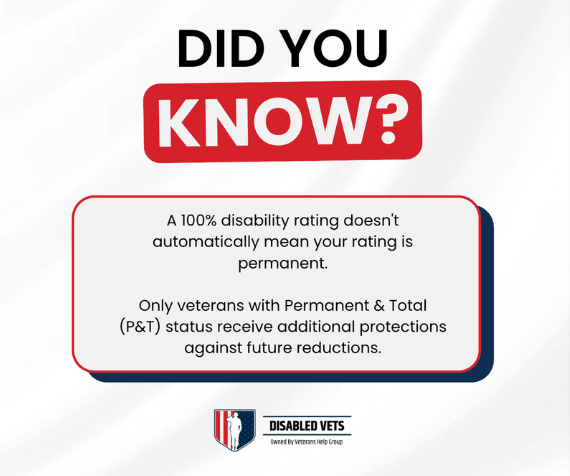
Yes. VA disability ratings aren’t automatically permanent unless the VA has designated your rating as protected, either through a 20-year continuous rating or a “permanent and total” (P&T) designation. The VA can reexamine your claim if it believes your condition has improved. A P&T designation removes the threat of future reductions and also opens additional benefits, including Chapter 35 educational benefits for dependents and potential property tax exemptions depending on your state.
What’s extraschedular TDIU, and how is it different from regular TDIU?
Regular (“schedular”) TDIU requires you to meet specific rating thresholds, one condition at 60% or more, or a combined 70% with one condition at 40% or more. Extraschedular TDIU, under 38 CFR 4.16(b), is for veterans who don’t meet those thresholds but whose service-connected conditions still prevent substantially gainful work. These claims get referred to the VA’s Director of Compensation Service for a special determination and generally need stronger vocational and medical evidence, since there’s no rating formula to lean on.
If my rating increases to 100% later, do I get back pay?
Often, yes. If the VA determines your condition met the 100% criteria (or TDIU criteria) as of an earlier date, your original claim date, or the date your condition worsened, you may be entitled to retroactive compensation back to that date. This is one of the most commonly missed pieces of a claim, since it depends on medical evidence showing exactly when your condition reached the qualifying severity, not just when the VA processed the paperwork.
Does TDIU pay the same as a 100% schedular rating for dependents too?
Yes. Once TDIU is granted, dependent compensation is calculated the same way it would be for a schedular 100% rating, a spouse, children, and dependent parents all add to the monthly payment using the same 100% rate tables.
Call 1-888-373-4722 or complete a Free Case Evaluation form
Read More On This
- VA Disability Ratings
- Types Of VA Disabilities
- Appealing a 70% VA Disability Rating to Secure a 100% Rating
- VA Benefits For Spouses of 100% Disabled Veterans
Call 1-888-373-4722 or complete a Free Case Evaluation form