


Most Common Veteran Disabilities and How They are Rated
Each year, the VA reports on the top conditions veterans are receiving VA disability benefits for. But if you’re receiving veterans disability benefits or are considering filing a claim, you know that benefits vary significantly. The amount of monthly compensation you receive, and your access to non-monetary benefits such as medical care depends on your VA disability rating.
With that in mind, it’s important to know how the VA rates common conditions and what the differences in those ratings can mean for you as a disabled veteran. It’s also important to understand that the rating criteria may be technical and complex and that there may be circumstances where a veteran is entitled to an extra-schedular rating.
Working with an experienced veterans disability benefits advocate from the beginning can eliminate the unknowns, reduce stress, and help avoid simple mistakes or omissions that can delay a claim or result in denial.
Top 6 VA Disabilities
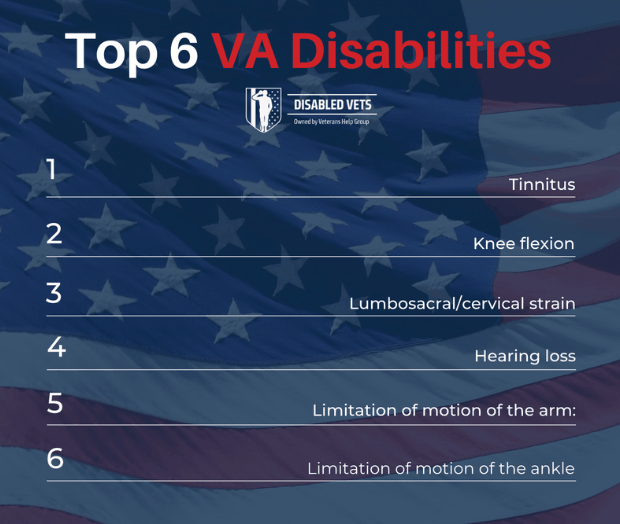
1. Tinnitus
Tinnitus is by far the most common condition veterans receive disability benefits for. According to the most recent VBA Annual Benefits Report, over 3.2 million veterans are currently receiving disability benefits for tinnitus — more than a million more than the next most common condition. In 2025 alone, 287,138 new recipients were added, more than any other condition on this list.
However, tinnitus is different from most conditions veterans receive benefits for, in that only one VA disability rating is possible. A veteran with service-connected tinnitus is entitled to a 10% disability rating. That’s true regardless of severity and regardless of whether it’s in one ear or both. A veteran with a disability rating for tinnitus can have a higher combined rating if they suffer from one or more other service-connected conditions. And, a very small percentage of veterans with tinnitus have been assigned an extra-schedular rating. However, the rating schedule for the condition contains only the 10% rating.
The VA has proposed eliminating the standalone 10% tinnitus rating under Diagnostic Code 6260, which would require tinnitus to be rated only as a symptom of another service-connected condition such as hearing loss, Ménière’s disease, or traumatic brain injury. As of mid-2026, no final rule has been published in the Federal Register, and the current 10% standalone rating remains in effect. Veterans who have not yet filed a tinnitus claim should be aware that this window may close, filing sooner rather than later locks in eligibility under the existing rules. Veterans who already hold a service-connected tinnitus rating are protected and will not have their existing rating reduced by any future rule change.
2. Limitation of Flexion of the Knee
Limited flexion of the knee comes in second. According to the most recent VBA Annual Benefits Report, over 2 million veterans are currently receiving VA disability benefits for the condition, with 162,407 new recipients added in 2025 alone.
With most conditions, there’s one rating schedule. If benefits are to be awarded, it will either be based on that schedule or due to an extraschedular determination. Knee flexion (and also hip flexion) conditions are a bit different. Under 38 CFR §4.71a, knee flexion conditions are to be evaluated under whichever of four different schedules yields the highest rating.
These differing listings also offer different ranges of disability ratings. On two of these schedules, the lowest possible rating is 0%. The top ends of the schedules range from 30% to 60%.
3. Lumbosacral or Cervical Strain
Lumbosacral and cervical strain ranks third among new claims. Over 1.6 million veterans are currently receiving VA disability benefits for one of these conditions, with 141,191 new recipients approved in 2025. These conditions are rated under the General Rating Formula for Diseases and Conditions of the Spine.
The ratings are based on the degree and nature of immobilization of the spine. Possible ratings are 10%, 20%, 30%, 40%, 50%, and 100%. At the lower end of the rating scale, there are multiple ways a veteran can qualify for that rating. However, at the higher end, the requirements are narrower. A 50% rating is assigned for unfavorable ankylosis of the entire thoracolumbar spine. A 100% rating is only assigned when the veteran has unfavorable ankylosis of the entire spine.
4. Hearing Loss
Hearing loss is common among veterans, due mostly to noise exposure associated with firearms and machinery used in training, combat, and many other military roles. Over 1.5 million veterans are currently receiving VA disability benefits for hearing loss, with 104,664 new recipients added in 2025.
The VA determines disability ratings for hearing loss through a very specific process. Two specific tests are required and must be administered by a licensed audiologist. The two required tests are the Maryland CNC test and the Pure-Tone audiometric test. The VA then uses a grid system to determine the appropriate disability rating, with possible ratings ranging from 0% to 100%. A veteran with a 100% disability rating due to hearing loss may be entitled to Special Monthly Compensation. It’s worth noting that if the proposed tinnitus rule change is finalized, veterans with service-connected hearing loss rated at 0% may still be able to receive a separate 10% rating for tinnitus — making it more important than ever to document both conditions thoroughly.
5. Post-Traumatic Stress Disorder (PTSD)
Post-traumatic stress disorder is by far the most common mental health condition veterans receive VA disability benefits for. Over 1.5 million veterans are currently receiving benefits for PTSD, with 92,917 new recipients approved in 2025.
PTSD is rated on the General Rating Schedule for Mental Disorders. The rating for PTSD and other mental health conditions depends on the degree of social and occupational impairment, with possible ratings of 0%, 10%, 30%, 50%, 70% and 100%. At the low end, a 0% rating is assigned when the veteran has been diagnosed with PTSD, but symptoms are not serious enough to impair social or occupational function and continuous medication is not required. At the other end of the spectrum, a 100% rating is assigned for total social and occupational impairment. The VA has also proposed changes to the mental health rating system that would introduce a five-domain functional assessment model and eliminate the 0% rating entirely, setting a minimum of 10% for any service-connected mental health diagnosis. As of mid-2026, this change remains proposed and has not been finalized.
6. Paralysis of the Sciatic Nerve
Paralysis of the sciatic nerve rounds out the top six. Over 1.7 million veterans are currently receiving VA disability benefits for the condition, with 92,947 new recipients approved in 2025.
Paralysis of the sciatic nerve is evaluated under 38 CFR §4.124a. The rating depends on the degree of paralysis, as follows:
- Mild – 10%
- Moderate – 20%
- Moderately severe – 40%
- Severe with marked muscular atrophy – 60%
- Complete – 80%
Additional Common Conditions for VA Disability
The following conditions also ranked among the top new claims in 2025, each with over 90,000 new recipients:
- Limitation of motion of the arm — 123,895 new claims in FY2025; over 1.2 million veterans currently receiving benefits
- Scars and burns — 96,273 new claims in FY2025; over 1.1 million veterans currently receiving benefits
- Migraine — 93,922 new claims in FY2025; over 1.1 million veterans currently receiving benefits
- Limitation of motion of the ankle — 92,184 new claims in FY2025; over 1.1 million veterans currently receiving benefits
Get the Help You Need with a VA Disability Claim
Whether you’re seeking veterans disability benefits for one of these common conditions or another disability, it’s important to submit the strongest possible claim. If you’re appealing a denial or attempting to raise your disability rating or receive TDIU classification to increase your benefits, it’s important to know what type of evidence the VA will be looking for.
At Disabled Vets, our advocates are fully dedicated to helping disabled veterans and their families get the benefits they deserve. We have extensive experience with the VA disability claims and appeals processes. To learn more about how we can put that experience to work for you, call (888) 373-4722 right now, or fill out our contact form here.
Frequently Asked Questions: VA Disability Ratings for Common Conditions
What is the most common VA disability claim filed by veterans?
Tinnitus is consistently the most common condition veterans receive VA disability benefits for. Over 3.2 million veterans are currently receiving compensation for the condition, and 287,138 new recipients were added in 2025 alone, more than any other condition.
What VA disability rating will I get for tinnitus?
Tinnitus has a fixed rating of 10%, regardless of severity or whether it affects one or both ears. If you have other service-connected conditions, those can be combined with your tinnitus rating to increase your overall disability percentage. The VA has proposed eliminating the standalone tinnitus rating, but as of mid-2026 no final rule has been published. The current 10% rating remains in effect. Veterans who haven’t yet filed should do so promptly, as filing under the current rules protects eligibility. Veterans with an existing rating are not affected by any future rule change.
How does the VA rate PTSD?
PTSD is rated based on the level of social and occupational impairment it causes. Ratings range from 0% to 100%, with common ratings at 10%, 30%, 50%, 70%, and 100%. A 100% rating is reserved for veterans experiencing total impairment in both social and work settings. The VA has proposed replacing this system with a five-domain functional model and eliminating the 0% rating, but this change is not yet final.
Can I receive VA disability benefits for hearing loss?
Yes. Hearing loss is one of the top five most common VA disability conditions by new claims. The VA uses two specific tests — the Maryland CNC test and the Pure-Tone audiometric test, administered by a licensed audiologist to determine your rating, which can range from 0% to 100%.
How is a back or neck strain rated by the VA?
Lumbosacral and cervical strains are rated under the General Rating Formula for Diseases and Conditions of the Spine. Ratings are based on how much the condition limits spinal movement and range from 10% all the way up to 100% in the most severe cases involving full spinal ankylosis.
What does an extra-schedular rating mean and can I qualify for one?
An extra-schedular rating applies when a veteran’s disability is so severe or unusual that the standard rating schedule doesn’t adequately capture the level of impairment. It’s not common, but it is an option worth exploring if your condition causes a significantly higher level of functional loss than your current rating reflects.
Does having multiple service-connected disabilities increase my overall VA rating?
Yes, the VA uses a combined ratings formula to calculate your overall disability percentage when you have more than one service-connected condition. It’s not simply adding the percentages together, so working with an experienced advocate can help make sure your combined rating accurately reflects the full impact of your disabilities.
Will the proposed VA rating changes affect my existing disability rating?
No. Veterans with existing service-connected ratings are protected. The proposed changes to tinnitus, sleep apnea, and mental health ratings would only apply to new claims filed after a final rule takes effect. As of mid-2026, none of these proposed changes have been finalized. If you have a pending or planned claim for any of these conditions, filing sooner rather than later means your claim is evaluated under the current rules.